

Toronto, Ontario - (News Release - September 30, 2020) - SideDrawer, the organization platform for...
Enterprise banks evaluating secure document exchange platforms face a deceptively simple question:
Should we create a vault (or drawer) for every client upfront?
A widely adopted best practice among mature institutions is to:
Provision vaults and drawers just-in-time, and focus architectural effort on entitlement governance and access control.
Vault creation is easy. Entitlement design is hard.
In this post, we’ll explore:
-
Why banks avoid pre-provisioning client vaults
-
How drawers become entitlement boundaries across business lines
-
The access control patterns that succeed in production
Vault Provisioning Isn’t the Hard Part
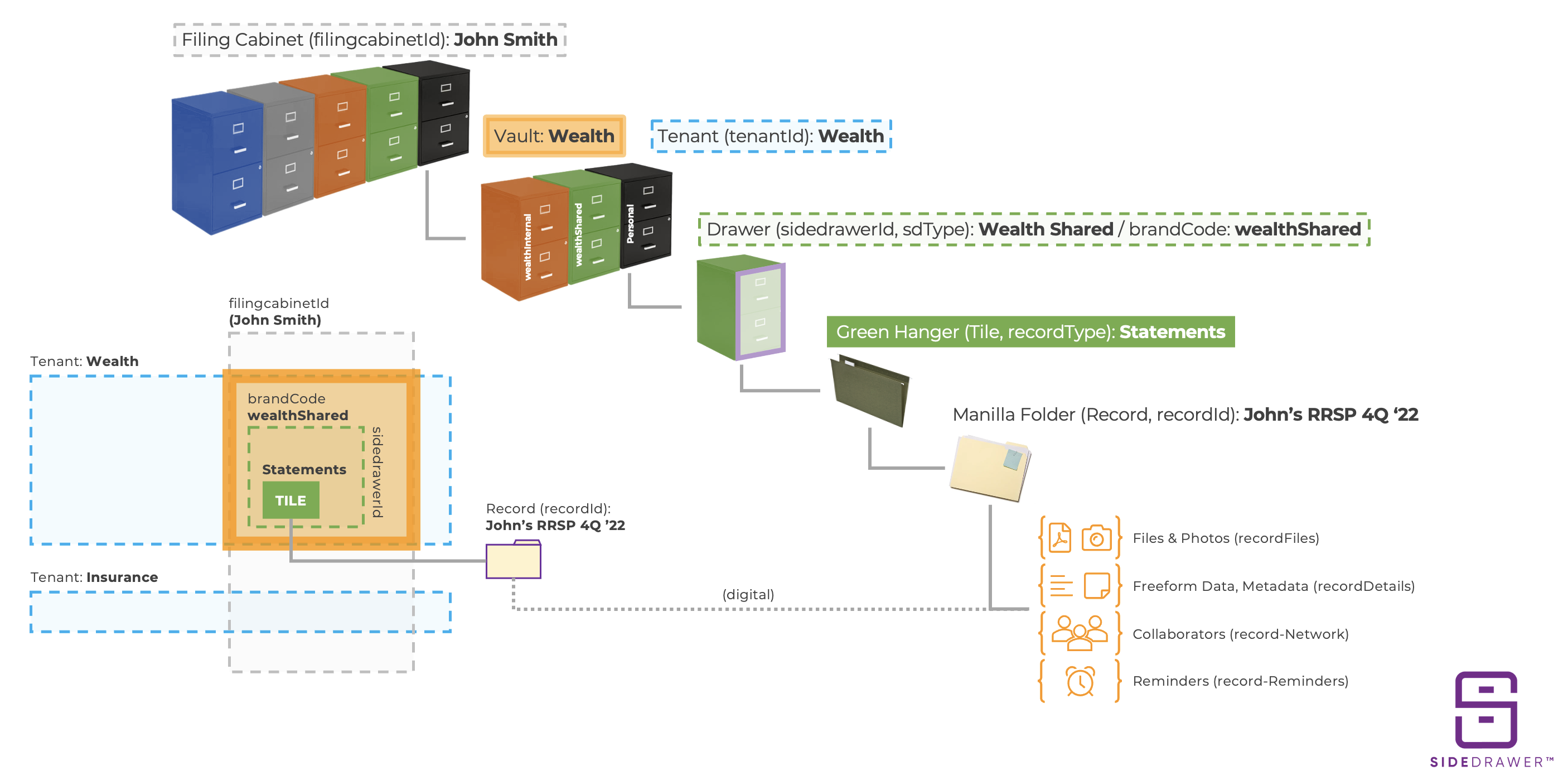
Platforms like SideDrawer provide a clear hierarchical container model for structuring client information:
-
Client Filing Cabinet – the conceptual root of the client’s secure document space
-
Tenant / Line of Business Context – wealth, insurance, commercial, etc.
-
Drawer – a governed workspace scoped to a business line or relationship type
-
Tile / Record Type – structured categories such as Statements, Tax, Lending
-
Record (Folder) – a specific workflow artifact (e.g., “John’s RRSP Q4 2022”)
-
Files + Metadata + Collaborators – the operational access boundary
The diagram below illustrates this structure clearly:
From an API and orchestration perspective, provisioning these components is operationally straightforward:
-
Create or reuse the client container
-
Create an appropriate line-of-business drawer
-
Attach collaborators based on policy
-
Trigger downstream workflows (forms, reminders, routing)
Technically, this can happen in seconds. But enterprise banks do not optimize for speed.
They optimize for:
-
Regulatory scope
-
Operational burden
-
Entitlement risk
-
Audit exposure
This is why leading institutions avoid pre-provisioning containers for all clients and instead adopt just-in-time provisioning triggered by governed workflows.
How Just-in-Time Vault Provisioning Works in Practice
Enterprise banks do not create vaults simply because a client record exists in a CRM. They create them when a specific workflow, in a specific business line, requires a controlled environment for document exchange.
Common triggers include:
| Workflow Context | Trigger Event | Provisioning Action | Access + Governance Outcome |
|---|---|---|---|
|
Wealth & Advisor-Led Engagements
|
An advisor initiates secure document collection inside a CRM widget
|
- Reuse or create the client container
- Create a wealth-specific drawer with deterministic metadata
- Apply standardized folder/record templates
|
Access is assigned based on advisor role, branch policies, and book-of-business entitlements.
Most institutions enforce one wealth drawer per client per LOB, programmatically.
|
|
Business Banking Onboarding
|
A banker triggers a “Create Digital Vault” workflow during onboarding
|
- Check for existing client container
- Add a commercial drawer if one exists
- Otherwise provision a new container + drawer
|
Collaborator roles are assigned based on customer vs prospect status, ensuring onboarding entitlements are scoped and auditable.
|
|
Prospect & New-to-Bank Journeys
|
A prospect submits an invitation or intake form
|
- Create vault/container if not present
- Provision an onboarding-tagged drawer
- Trigger smart forms, reminders, and workflow follow-ups
|
External access is typically time-bound and restricted, with contributor permissions governed by onboarding state and compliance policy.
|
The key principle is consistent:
Vaults and drawers are created only when a regulated workflow justifies their existence — not because a party record exists elsewhere.
This reduces unused containers and ensures entitlements emerge only when business context requires them.
Client Vaults Are Entitlement Boundaries, Not File Repositories
For large institutions, a client vault is not simply storage. It is the entitlement boundary spanning the client’s engagements across multiple business lines.
A typical high-net-worth client vault may have drawers such as:
Wealth Advisory · Direct Investing · Private Banking · Insurance · Trust & Estate
One Vault With Three Different Perspectives
| Client Experience | Employee Experience | Bank Governance Reality |
|---|---|---|
| One unified digital vault | Only entitled drawers appear by default | Segmented drawers by line of business |
| Seamless collaboration | Guided workflows aligned to role and context | IAM-driven entitlement enforcement |
| Simple document exchange | Clear routing into the correct governed container | Information barriers + audit readiness |
This model enables:
-
Clear segregation by business line
-
Need-to-know access enforcement
-
Controlled collaboration without cross-LOB leakage
Entitlement Governance Patterns at Enterprise Scale
Across institutions, several architecture patterns emerge consistently.
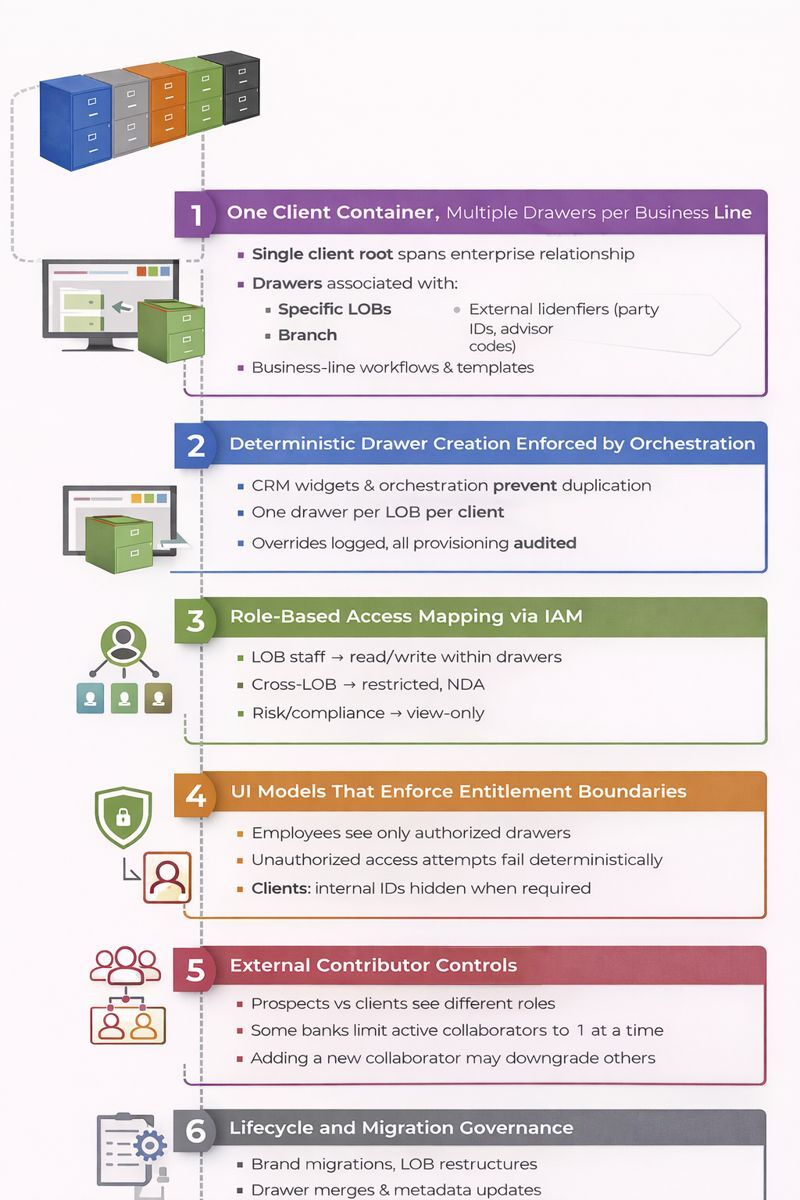
All while preserving:
-
Documents
-
Audit history
-
Traceability between source and surviving containers
Why Governance Matters More Than the Share Button
Enterprise buyers are not primarily concerned with UI-level convenience features.
They are concerned with:
-
Preventing cross-LOB leakage
-
Meeting regulatory obligations across repositories
-
Supporting audit cycles (who had access, when, and why)
-
Automated access revocation tied to workflow state
-
Avoiding privilege creep over time
The challenge is architecting entitlements so that provisioning is deterministic, governed, and audit-ready.
The Enterprise-Grade Pattern
The strongest deployments converge on a consistent model:
-
Just-in-time vault and drawer creation
-
One client container, one drawer per line of business
-
Role- and LOB-mapped access encoded in IAM and orchestration
-
Segmentation controls enforced in both UI and API
-
Lifecycle ownership aligned to retention and deactivation policies
-
Full auditability of provisioning, overrides, and entitlement changes
Final Thought: Technology Enables, Governance Determines Success
Platforms like SideDrawer provide the structural elements:
-
Client containers
-
LOB-specific drawers
-
Role-based collaboration
-
APIs for real-time provisioning
-
Integrations with CRM, IAM, and enterprise content systems
But at enterprise scale, success depends far more on entitlement governance:
Design the entitlement model per line of business, codify it across systems, and let just-in-time provisioning follow from those rules.
That is where the real enterprise complexity lives and where the most meaningful value is delivered.