

We hope you're enjoying a safe, restful holiday season! As we reflect on 2024, our clients'...
Financial Services need workflow-aware systems of record.
When the records and documents that crucial client service workflows depend on are scattered across inboxes, shared drives, portals, and point solutions, work becomes fragile. Completion rates drop. Follow-ups multiply. Teams rely on tribal knowledge.
Clients don’t experience this as a systems issue. They experience it as delay, repetition, and inconsistency.
Records that exist vs. records that run the work
|
Records That Exist |
Records That Run the Work |
|
Stored as files |
Structured within workflows |
|
Located manually |
Located by status and context |
|
Versions drift over time |
Single authoritative version |
|
Re-requested from clients |
Reused across processes |
|
Reconstructed during reviews |
Operational at creation |
Client service is not a single event. It is a series of workflows that repeat over time:
-
onboarding and account opening
-
regulatory and KYC refreshes
-
periodic reviews
-
ad-hoc servicing requests
-
approvals, attestations, and disclosures
A workflow-aware system of record closes this gap by preserving not just the document, but the context that makes it usable: what it is, who it applies to, its status, and how it supports downstream work.
How records are created through workflows
 In practice, reliable records are not created by storage. They are created by execution. When intake is structured, instructions are clear, and status is visible, the result is not just “a file uploaded.” The result is an authoritative record that downstream teams can rely on without reconstruction.
This distinction becomes clear when looking at two very different, but closely related, examples.
Example 1: W-8 and W-9 tax forms (Ongoing lifecycle management)
Consider W-8 and W-9 tax forms for investment accounts holding U.S.-domiciled securities.
Most firms can locate these forms somewhere. The harder problem is operationalizing them over time:
-
ensuring the correct form applies to the correct accounts
-
tracking expiration and renewal requirements
-
avoiding repeated requests when a valid form already exists
-
supporting downstream withholding, reporting, and audit workflows
When these forms live as disconnected files, teams rely on spreadsheets, email threads, or memory. When they live in a workflow-aware system of record, status and ownership are visible. Validity is clear. Downstream processes can rely on the record without rework.
The client experiences fewer requests. Operations experiences fewer exceptions. Compliance gains confidence that the right evidence exists when needed.
Example 2: Enterprise Small Business Banking onboarding (Front-loaded record creation at scale)
This example reflects an enterprise Small Business Banking implementation.
A business customer is onboarded by a large financial institution and receives a digital invitation to complete onboarding securely through the institution’s digital vault.
On first access, the business owner or authorized signer:
-
reviews and accepts required privacy consents and regulatory disclosures
-
understands why both business and personal information is being collected
They are then guided through a structured onboarding flow to provide the business identity information the institution will rely on for account setup, credit, and compliance, including:
-
legal business name, jurisdiction, and business number
-
corporate identification numbers where applicable
-
legal structure (corporation, partnership, sole proprietorship, association)
In parallel, the customer completes the full KYC / customer information file:
-
beneficial ownership and controlling persons
-
addresses and contact details
-
required personal information for key principals
Where data has been pre-populated from external registries, gaps can be corrected directly thereby reducing downstream exceptions. Finally, the customer uploads required business documents such as articles of incorporation, partnership agreements, and identification materials.
From the client’s perspective, this is a single, guided onboarding journey and not a mix of emails, branch visits, and ad-hoc uploads.
Two ends of the same problem
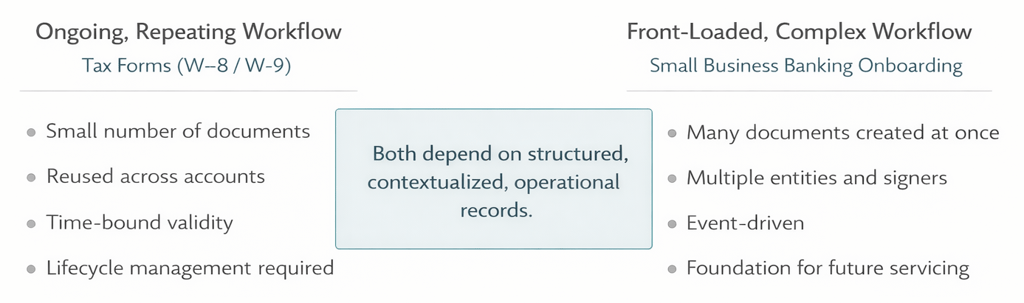
These examples sit at opposite ends of the spectrum:
-
a narrow, repeating workflow (tax forms)
-
a broad, front-loaded workflow (business onboarding)
But they depend on the same foundation.
When records are structured, contextualized, and operational at the moment they are created, they can be reused across servicing, reviews, and regulatory workflows. When they are not, teams are forced to reconstruct history later.
Where SideDrawer fits
SideDrawer is designed to function as a workflow-aware system of record for client documents and information exchange.
It does not replace CRMs, custodians, or core banking systems. Instead, it provides the layer that ensures document-heavy workflows are executed consistently across the client lifecycle.
By preserving both records and the context in which they were created, SideDrawer helps firms reduce friction in everyday servicing, avoid repeated document requests, and rely on records without reconstruction.
A simple way to evaluate your current state
Ask a few practical questions:
-
Can multiple teams service the same client without re-requesting documents?
-
Can you see what is outstanding, complete, or expiring without email threads?
-
Can onboarding produce records downstream teams can immediately trust?
If the answer is “sometimes,” you likely have records—but not a record system designed for execution.
Closing
Clients rarely judge financial firms by the sophistication of their technology stack.
They judge reliability:
-
Do you remember what I already provided?
-
Can you move quickly without losing accuracy?
-
Can you serve me consistently across people, teams, and time?
A workflow-aware system of record is what makes that reliability repeatable.