
Information barriers enforced architecturally
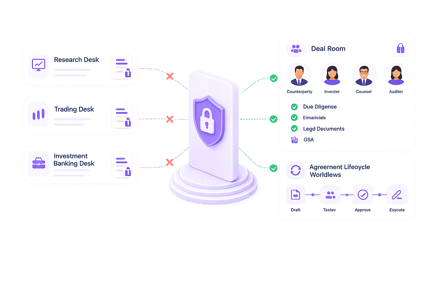
Capital markets operations require strict information barrier enforcement between desks, deal rooms with full counterparty access management, and agreement lifecycle workflows that email-based exchange cannot support.
The Information Control Problem
Policy-based information barriers fail when documents move over email. Architecture doesn't.
Information barriers that exist on paper, not in the system
When deal documents are shared over email or generic collaboration tools, the barrier is only as strong as the policy. If an email is forwarded to the wrong desk, the barrier is breached. There's no architectural enforcement — just a compliance incident.
Deal room audit records that can't survive regulatory examination
Counterparty access management, document version history, and access log reconstruction from email threads and shared drives doesn't constitute an auditable deal record. Regulators expect a complete, immutable log — not a reconstruction.
Agreement lifecycle managed across disconnected systems
Master agreements, schedules, and annexes created in one place, negotiated in email, executed in a signing tool, and archived in ECM. No single system holds the complete agreement record.
Dedicated Container Architecture
Each deal, each LOB, each counterparty relationship operates in an isolated container with RBAC that travels with the document.
-
Dedicated container per LOB or deal Architecturally enforced information barriers; no data co-mingling across environments
-
Deal rooms with version control Full counterparty activity log; document access management; every version tracked
-
Semantic search across agreement portfolios Natural language queries across ISDA master agreements, schedules, and annexes; RBAC-enforced so users only search within permitted scope
-
ISDA and trading agreement lifecycle Master agreement, schedule, and credit support annex managed together in one vault
-
KYC and KYB workflows for institutional client onboarding Structured collection with back-office approval routing
-
Re-papering at scale Bulk document distribution with metadata-based routing per counterparty
-
Counterparty access management External parties access their scoped deal room without internal system access
-
Audit trail for regulatory examination Every document interaction logged with timestamp, user, and device; immutable and exportable
“We know secure collaboration is top of mind for every financial professional, and increasingly among our investor clients as well. We’re excited to be able to offer such an excellent user experience but one that’s also highly secure.”Dale Hawthorn — BCV Asset Management
Built for Capital Markets Operations
Structural information control across every deal, every counterparty, every agreement.
Architectural information barriers
Each LOB environment, deal room, and counterparty relationship operates in an isolated container. RBAC controls travel with documents through every stage. Information leakage between desks is architecturally prevented — not policy-dependent.
Agreement lifecycle management
ISDA master agreements, schedules, and credit support annexes managed in one vault. Version history, counterparty access, and execution record in one place. Semantic search across the full agreement portfolio with RBAC-enforced results.
Re-papering at scale
Bulk document distribution with metadata-based routing per counterparty. Each counterparty receives the correct document variant. Delivery confirmation and access log captured automatically per counterparty.
Semantic search
Natural language queries across thousands of agreements. Find specific clause language, identify termination events, and surface counterparty-specific terms without manual document review. Results RBAC-enforced to the user’s permitted scope.
What Capital Markets Technology Teams Ask
Questions from COOs, operations leads, and compliance teams during enterprise evaluation.
How are information barriers enforced architecturally rather than by policy?
Each LOB, deal environment, and counterparty relationship is deployed as an isolated container with separate RBAC configuration. There is no shared infrastructure between environments — data co-mingling is architecturally prevented. A user with access to one deal room cannot view, query, or detect the existence of another. This is a structural guarantee, not a contractual commitment.
What does a deal room look like in practice?
A deal room is a dedicated vault with configured counterparty access. Counterparties are invited with RBAC-scoped access — they see only their documents. Every access event, upload, download, and version change is logged in an immutable audit trail. When the deal closes, the complete deal record — documents, access log, and timeline — is available for archival or regulatory review.
How does semantic search work across thousands of agreements?
SideDrawer's semantic search uses OCR and vector embedding to make document content queryable in natural language. A compliance officer can search "agreements with automatic early termination triggered by credit downgrade" and surface the relevant counterparty agreements across the portfolio. Results are RBAC-enforced — users only surface agreements within their permitted access scope.
How does re-papering work at scale?
Re-papering workflows use metadata-based routing to distribute the correct document variant to each counterparty. Bulk distribution is triggered from the platform; each counterparty receives their scoped document with a one-time authenticated link. Delivery confirmation and access are logged per counterparty. Status across the full re-papering exercise is visible on a single dashboard.
What data isolation guarantees apply at the enterprise PaaS tier?
Enterprise PaaS deploys a fully dedicated multi-cloud environment — dedicated Azure or AWS tenant, client-held encryption keys, all PII and metadata stored exclusively within the client's own tenant. SideDrawer does not have access to client data in this configuration. Physical segregation applies at every layer including the Keycloak authentication engine.
Is data residency confirmed for institutional deployments?
Yes. All data at rest stored in the client's preferred region. Enterprise PaaS architecture supports client-held encryption keys and configurable geographic data routing for institutions with cross-border residency requirements.
How SideDrawer Works for Capital Markets
Common questions from capital markets technology and operations teams. For a full architecture walkthrough, book an enterprise discovery call.
Ready to enforce information barriers structurally — not by policy?
Book an enterprise discovery call. We’ll walk through the container architecture, deal room configuration, and agreement lifecycle workflow for your capital markets environment.
Book an Enterprise Discovery Call