
A family’s entire financial life. One vault. One source of truth across generations.
Family offices coordinate lawyers, accountants, estate trustees, multiple generations of family members, and investment managers — all of whom need access to overlapping sets of documents. SideDrawer gives the family office one authoritative vault per household, with permissions defined by relationship — not by email thread.
The Multi-Generational Coordination Problem
A family office can serve one family across multiple generations. The document record is scattered across six inboxes.
No single authoritative document source
The estate lawyer has one version of the will, the accountant has another, the trustee a third, and two family members have copies forwarded from emails sent two years ago. Nobody knows which is current. The family office becomes the clearinghouse for a fragmentation problem it didn’t create.
Third-party access that requires forwarding files
Every time the estate attorney needs updated documents, someone at the family office forwards them over email. That file is now outside any controlled environment. It lives in the attorney’s inbox, possibly forwarded further, with no record of who has it.
Succession planning that starts from scratch
When a family patriarch or matriarch passes, the successor family members often have no access to the documents that govern the estate. Reconstructing the record from scattered inboxes and shared drives is the first task in what should be a period of support, not archaeology.
The Family Vault Model
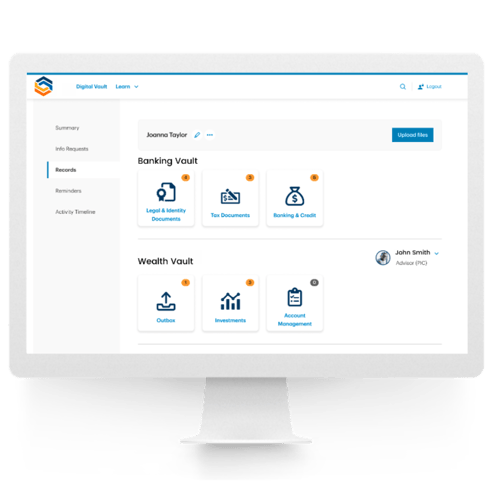
Private drawers for individuals. Shared drawers for the household. One vault for the relationship.
-
Private and shared drawers Individual family members have private drawers; shared household documents live in shared drawers accessible to all permitted parties
-
Multi-generational access structure Adult children, trustees, and next-generation family members are added with scoped permissions; they see what they’re supposed to see
-
Third-party collaborator model Estate lawyers, accountants, and external trustees are added to the vault with RBAC-scoped access; nothing goes over email
-
Vault as authoritative document source Resolves version fragmentation; one current version of every document, accessible to all permitted parties simultaneously
-
Immutable audit trail Every document interaction logged with timestamp and user attribution; available for estate settlement and compliance review
-
Succession-ready structure When a family member passes, the vault is already organized and accessible to named successors; no reconstruction required
-
Cross-vault search The family office searches across all client relationships; RBAC-enforced so staff only surface what they’re permitted to see
“The beauty of the collaboration is that we can set those levels of connection with family members so that we encourage families to have this level of transparency.”Frank Gasper — CSR Wealth
Built for Family Office Operations
The operational infrastructure families and their advisors have been missing.
Household vault architecture
Private drawers for individuals, shared drawers for the household. Every family member sees exactly what they’re supposed to — nothing more, nothing less.
Third-party ecosystem
Estate lawyers, accountants, and external trustees are added as collaborators with scoped access. The family office controls who sees what. Nothing leaves the vault over email.
Succession-ready by design
Named successors are configured in advance. When succession occurs, access is already structured. The document record is complete. The family office begins from an organized position, not a reconstruction exercise.
Audit trail for every generation
Every document interaction logged with timestamp and user attribution. The complete chain of custody is available for estate settlement, regulatory review, or family disputes — without anyone having to reconstruct anything from inboxes.
From Practitioners
When families can see their documents clearly, the advisor relationship compounds.
“SideDrawer was a natural fit for our practice because we are constantly collaborating – we are helping our clients, and our clients are helping their parents.”Frank Gasper — CSR Wealth
“SideDrawer is a core part of our business process, and how we engage with our clients.”Jill Chambers — Financial Concierge
deployed
SideDrawer
interaction
data residency
Common Questions
What family offices ask before they start.
How do we give different family members different levels of access?
RBAC permissions are set at the vault, drawer, and file level. A family member can be given view-only access to shared documents. A trustee can be given upload access to specific drawers. Permissions are fully programmable and can be updated instantly.
Can external advisors (lawyers, accountants) access the vault without being on our platform?
Yes. External collaborators are invited to the vault with scoped permissions. They log in through the family office’s branded portal, see only what they’re permitted to see, and their activity is logged in the same audit trail as all other users.
What happens to vault access when a family member passes?
The practice decides how to handle these - and it should not be any different than the file folders in your filing cabinet at the office. Pre-configured access can be provided through the No Details permission - but many family offices manage this process as it happens given the changing circumstances.
Is there a private/shared drawer model for household vs. individual documents?
Yes. Each vault supports private drawers (visible only to the named individual) and shared drawers (visible to all permitted household members). The family office controls the structure. Family members see their private documents and the shared household documents — nothing else.
Is Canadian or US data residency confirmed?
Yes. All data at rest is stored in Canada, US or any of the 75+ regional data centers - the system is designed to meet the residency requirements.
How do we handle a family office that serves multiple unrelated family households?
Each household is its own vault with its own permission structure. There is no data co-mingling between households. The family office sees all households from a single dashboard; each household only sees its own vault.
How SideDrawer Works for Family Offices
Common questions from family office principals and operations staff. If you need more detail, book a private walkthrough — we’ll walk through the platform with your household structure in mind.
Ready to give every family relationship a permanent, organized home?
Book a private walkthrough — we’ll show you how SideDrawer works for family office operations, multi-generational access structures, and third-party collaboration.
Book a Private Walkthrough