
Policy e-delivery, claims workflows, and beneficiary coordination — without email attachments.
Insurance enterprises manage sensitive documents across advisor networks, policyholders, beneficiaries, and compliance teams — each with different authentication, retention, and audit requirements.
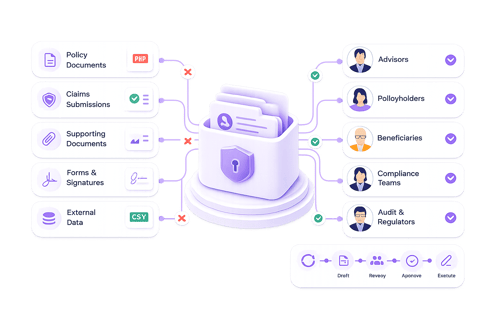
The Multi-Channel Document Problem
Three lines of business. Three different document workflows. One compliance team holding it all together.
Policy delivery that generates no audit record
Email-based policy delivery satisfies the send requirement. It doesn’t satisfy the receipt requirement. When a policyholder disputes having received a disclosure or policy document, a sent-email record isn’t sufficient evidence of delivery or acknowledgement.
Beneficiary and executor coordination over email
When a policyholder passes, beneficiaries and executors need access to policy documents, claims forms, and settlement instructions. Coordinating this over email — with attachments forwarded across parties — creates version fragmentation, delays, and a compliance record that can’t be reconstructed cleanly.
Group plan member document requests with no intake structure
Group plan administrators collect member documentation through a combination of email and paper. There’s no structured intake, no completion status visibility, and no automatic routing to back-office processing. Each renewal cycle is a manual exercise.
Multi-LOB Vault Architecture
One enterprise deployment. Isolated tenant per line of business. One authentication infrastructure.
-
Policy e-delivery to policyholders — authenticated, auditable, no email attachments Delivery and acknowledgement logged per document; every access event timestamped and attributed
-
Beneficiary and executor access — heir-aware RBAC Access governed by configurable conditions (e.g., activation upon documented event); no manual grant required at time of event
-
Back-office approval and reject workflows Claims and compliance review routed automatically; inline commenting; all steps logged
-
Isolated tenants per LOB Wealth, Individual Insurance, and Group Benefits each operate as separate tenants; no cross-LOB data exposure
-
Group plan member document requests System-generated structured requests feed back into automated back-office workflows
-
Protected B self-assessment completed Official certification available as pre-go-live condition
-
Full audit trail Every document interaction logged; exportable for regulatory examination or claims dispute resolution
-
SSO via Okta or Azure Entra Shared authentication infrastructure across all LOBs; no separate identity system per line of business
“Cybersecurity is one of the things that keeps me up at night.”Frank Gasper — CSR Wealth
Built for Insurance Enterprises
The document infrastructure your policyholders, advisors, and compliance teams need — across every line of business.
Authenticated policy e-delivery
Policyholders receive documents in a vault under your brand. Delivery and acknowledgement are logged with timestamp and user attribution. When a dispute arises, the record is complete.
Beneficiary and executor access
Heir-aware RBAC lets you configure access conditions in advance. When a triggering event occurs, the right parties gain access to the right documents automatically — without an advisor or administrator manually forwarding anything.
Multi-LOB tenant isolation
Each line of business operates in a structurally isolated environment. Data co-mingling between Wealth, Insurance, and Group Benefits is architecturally prevented. One authentication infrastructure serves all three.
Claims and compliance workflow
Submitted claims documents route to reviewers automatically. Back-office teams approve or reject inline — with comments in the audit log. No email round-trips. No manual status tracking.
From the Market
Deployed across insurance and wealth lines of business at Tier1 financial institutions.
“We know secure collaboration is top of mind for every financial professional, and increasingly among our investor clients as well. We’re excited to be able to offer such an excellent user experience but one that’s also highly secure.”Dale Hawthorn — BCV Asset Management
“No Advisor would give up SideDrawer. The impact to their practice and client experience is too positive.”Yevheniia Vostrikova — New Outlook Wealth
What Insurance Technology Teams Ask
Questions from CIOs, COOs, and compliance teams during insurance enterprise evaluation.
How does policy e-delivery create an audit record of receipt — not just delivery?
SideDrawer logs every document access event — when the policyholder opens the document, how long it was viewed, whether it was downloaded, and whether an acknowledgement was completed. This creates a multi-event delivery record: sent, opened, acknowledged. When a dispute arises, the record is complete and timestamped.
How does beneficiary and executor access work without an active policyholder account?
Beneficiary and executor access is configured in advance using heir-aware RBAC. Access conditions are set — for example, access activates upon submission of a certified death certificate. When the condition is met, the designated parties receive access to their scoped documents automatically. No administrator needs to manually grant access at the time of the event.
How is cross-LOB data isolation enforced between Wealth, Insurance, and Group Benefits?
Each LOB can be deployed as a structurally isolated tenant — separate data store, separate RBAC configuration, and separate access controls. There is no shared infrastructure layer between LOBs. A user in the Group Benefits tenant cannot view, query, or detect the existence of data in the Insurance or Wealth tenants, even within the same enterprise deployment.
What does Protected B certification mean for our regulatory posture?
SideDrawer can provide Protected B certification if required as part of a commercial contractual agreement.
How do group plan member document requests integrate with our back-office processing?
System-generated document requests are sent to group plan members via structured vault invitations. Members upload documents through the vault — no account required. Completed submissions trigger webhook notifications to your back-office processing systems. Back-office teams review and approve inline within the platform. Every step is logged.
Is US or Canadian data residency confirmed for insurance deployments?
Yes. All data at rest stored in Canada, US or a region of the firm's choice. Enterprise PaaS tier provides fully dedicated multi-cloud environment within your own tenant with client-held encryption keys.
How SideDrawer Works for Insurance Enterprises
Common questions from insurance technology and compliance teams. Book an enterprise discovery call to walk through multi-LOB architecture and policy e-delivery workflows for your specific lines of business.
Ready to deploy auditable document infrastructure across your lines of business?
Book an enterprise discovery call. We’ll walk through multi-LOB tenant architecture, policy e-delivery workflows, and beneficiary access configuration for your specific business lines.
Book an Enterprise Discovery Call